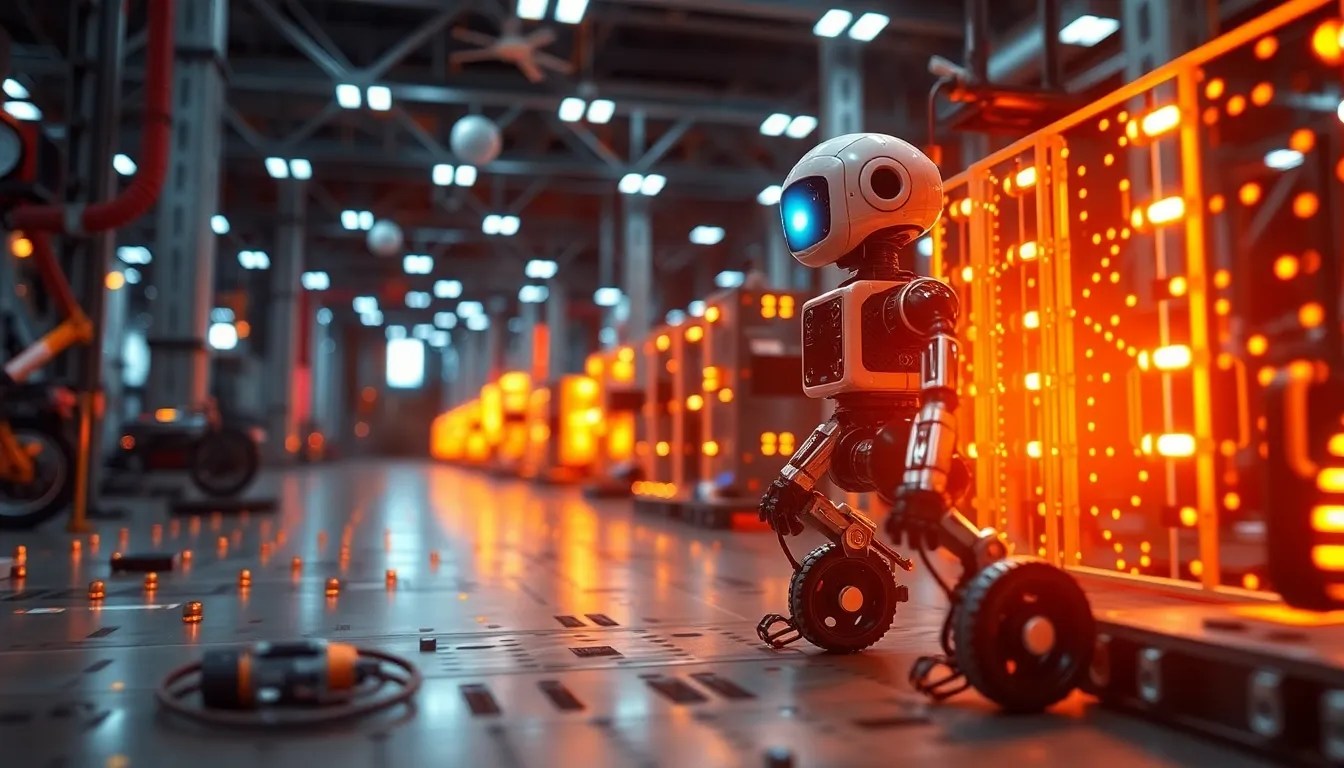
How Sensors Are Allowing Robots to Navigate Complex Environments
I. Introduction
Robotic navigation plays a pivotal role in the development of autonomous systems, enabling robots to traverse and interact with their environments effectively. The ability to navigate complex terrains, recognize obstacles, and adapt to dynamic conditions is essential for a variety of applications, from manufacturing and logistics to healthcare and domestic environments.
At the heart of robotic navigation lies an array of sensors that provide critical data about the robot’s surroundings. These sensors enable robots to make informed decisions, ensuring accurate and safe navigation. This article aims to explore the evolution of robotics and navigation, the types of sensors utilized, the concept of sensor fusion, the integration of machine learning, challenges faced in navigation, and future trends shaping the field.
II. The Evolution of Robotics and Navigation
The journey of robotics and navigation technology has been remarkable, marked by significant advancements over the decades. Initially, robots were confined to predictable environments, executing simple tasks with limited mobility. As technology progressed, the need for robots to navigate complex environments became apparent.
Key milestones in this evolution include:
- The introduction of basic sensors in the 1960s, which allowed robots to sense their immediate surroundings.
- The development of more sophisticated sensors in the 1980s, including Lidar and advanced computer vision systems.
- Recent advancements in artificial intelligence and machine learning, enhancing robots’ ability to learn from their environments.
III. Types of Sensors Used in Robotics
Robots utilize a variety of sensors to gather information about their environment. Each type of sensor serves a unique purpose, contributing to the overall navigation capabilities of the robot.
A. Lidar: Mapping and distance measurement
Lidar (Light Detection and Ranging) is a crucial sensor in robotic navigation, providing high-resolution 3D maps of the environment. By emitting laser pulses and measuring the time it takes for them to return, Lidar can accurately determine distances and create detailed spatial representations.
B. Ultrasonic sensors: Proximity detection
Ultrasonic sensors are widely used for proximity detection. They work by emitting ultrasonic waves and measuring the time it takes for the waves to bounce back. This technology is particularly effective in avoiding obstacles and determining the distance to nearby objects.
C. Cameras and computer vision: Visual processing
Visual sensors, including cameras, allow robots to interpret their surroundings visually. Computer vision algorithms analyze images to identify objects, track movements, and even recognize faces, enhancing the robot’s situational awareness.
D. Inertial measurement units (IMUs): Orientation and motion tracking
IMUs combine accelerometers and gyroscopes to track the robot’s orientation and movement. This data is essential for maintaining stability and ensuring accurate navigation, particularly in dynamic environments.
E. Environmental sensors: Temperature, humidity, and other variables
Environmental sensors measure various factors, such as temperature, humidity, and air quality. These sensors are crucial for robots operating in sensitive environments, such as healthcare facilities or agricultural settings.
IV. Sensor Fusion: Enhancing Navigation Accuracy
Sensor fusion refers to the process of integrating data from multiple sensors to improve navigation accuracy and reliability. This approach allows robots to develop a more comprehensive understanding of their environment.
A. Definition of sensor fusion and its importance
Sensor fusion combines information from different sources to produce more accurate and reliable data than any single sensor could provide. This is particularly important in robotics, where complex environments can present challenges that require nuanced understanding.
B. Techniques for combining data from multiple sensors
Various techniques are employed for sensor fusion, including:
- Kalman filtering: A mathematical method used to estimate the state of a dynamic system from a series of noisy measurements.
- Particle filters: A computational approach that represents the probability distribution of a system using a set of particles.
- Neural networks: Machine learning models that can learn patterns and relationships in data from multiple sensors.
C. Real-world applications showcasing successful sensor fusion
Many modern robots effectively utilize sensor fusion. For example, self-driving cars integrate Lidar, cameras, and IMUs to navigate safely through urban environments, dynamically adjusting to changes such as traffic and pedestrians.
V. Machine Learning and Sensor Integration
Machine learning plays a crucial role in enhancing robotic navigation by enabling robots to interpret sensor data and adapt to their environments.
A. Role of machine learning in interpreting sensor data
Machine learning algorithms can process large amounts of data from various sensors, identifying patterns and making predictions about the environment. This capability allows robots to make informed decisions based on real-time data.
B. Examples of algorithms used for navigation
Common machine learning algorithms in robotic navigation include:
- Reinforcement learning: A method where robots learn through trial and error, receiving rewards or penalties based on their actions.
- Convolutional neural networks (CNNs): Deep learning models particularly effective for image classification and visual processing tasks.
C. Case studies of robots that adapt to their environments through learning
Robots like Boston Dynamics’ Spot and autonomous drones exemplify the successful integration of machine learning for navigation. These robots can adapt their movements based on real-time feedback from their sensors, allowing them to navigate complex environments efficiently.
VI. Challenges in Navigating Complex Environments
While advancements in sensors and algorithms have significantly improved robotic navigation, challenges remain in navigating complex environments.
A. Obstacles and dynamic elements in real-world settings
Real-world environments are often unpredictable, with moving obstacles and varying terrain that can hinder navigation.
B. Limitations of current sensor technologies
Current sensor technologies have limitations, such as:
- Vulnerability to environmental conditions (e.g., fog, rain) that can affect sensor accuracy.
- High costs associated with advanced sensors like Lidar.
C. Safety and ethical considerations in autonomous navigation
Ensuring safety in robotic navigation is paramount. As robots become more autonomous, ethical considerations regarding their interactions with humans and the environment also arise, necessitating careful regulatory frameworks.
VII. Future Trends in Robotic Navigation
The future of robotic navigation is poised for exciting developments driven by innovation in sensor technologies and advancements in artificial intelligence.
A. Innovations on the horizon: New sensor technologies
Emerging technologies, such as quantum sensors and advanced multispectral imaging systems, promise to enhance the capabilities of robots to navigate complex environments.
B. The impact of AI and deep learning on navigation strategies
AI and deep learning are expected to revolutionize navigation strategies, enabling robots to learn from experience and improve their navigation abilities over time.
C. Predictions for the future of robotics in various sectors
The impact of improved navigation technologies will be felt across various sectors, including:
- Healthcare: Robots assisting in surgical procedures and patient care.
- Agriculture: Automated systems managing crops and livestock.
- Logistics: Drones and autonomous vehicles optimizing delivery systems.
VIII. Conclusion
In summary, sensors are integral to the navigation capabilities of robots, enabling them to traverse complex environments with precision and efficiency. As technology continues to evolve, the potential for robotics in various sectors expands, paving the way for innovative applications that were once thought to be the realm of science fiction.
As we look towards the future, continued exploration and investment in sensor technology will be vital for overcoming current challenges and unlocking the full potential of robotic navigation. The journey is just beginning, and the possibilities are endless.


